Why Choose Sound Absorbing Panels for Your Project?
A meeting room can look finished yet still sound tiring. Voices bounce from glass, painted drywall, and a bare ceiling. In classrooms, offices, restaurants, and studios, that reverberation can blur speech and make conversations feel effortful. A Sound Absorbing Panel helps by reducing reflected sound inside a room. It is not the same as soundproofing. Panels generally do not block noise passing through walls or windows.
The European Environment Agency’s Environmental Noise in Europe 2020 report estimated that at least 113 million people in Europe were exposed to long-term road traffic noise at 55 decibels or more. That finding concerns environmental noise, not panel performance. Still, it highlights why acoustic design deserves attention. In a 2011 World Health Organization statement, Dr. Maria Neira warned, “Noise is an underestimated threat.” Her comment is a reminder to treat sound as part of a space’s function, not merely its finish.
Good choices start with the room. Note where people speak, listen, and work; then consider ceiling height, hard surfaces, and existing furnishings. ASTM C423 and ISO 354 describe laboratory methods for measuring sound absorption, so compare products using documented test results. Check how the reported rating was measured, and ask whether it reflects the installation you plan. A panel’s color may catch the eye. Its placement and tested performance matter more.
No panel fixes every room. A small, reflective space may need a different layout than a busy open office. Review the measurements, test a sample when possible, and leave room to revise the plan.
What Sound-Absorbing Panels Are and How They Work
Sound-absorbing panels are usually made from porous or fibrous materials. Sound waves enter their open structure, where friction converts some acoustic energy into tiny amounts of heat. Less sound returns to the room as an echo. The effect is especially useful in busy spaces with hard floors, glass, and bare walls. Panels reduce reflections; they do not block sound passing through walls. That difference matters.
ASTM C423 test reports measure sound absorption in a reverberation room. They provide results across frequencies, while the familiar Noise Reduction Coefficient, or NRC, averages results at 250, 500, 1,000, and 2,000 hertz, rounded to the nearest 0.05. An NRC of 0.80 suggests strong average absorption across those bands, not equal performance at every pitch. A low hum may remain. The ASHRAE Handbook—Fundamentals also treats room acoustics as dependent on surfaces, volume, and frequency. So a panel rating alone cannot predict a room’s final sound. Panel thickness, spacing, mounting, and placement all affect performance; a small test installation can reveal surprises.
A rating is not a room.
How Panels Improve Room Acoustics
Hard surfaces send speech bouncing across a room. Sound-absorbing panels add porous surfaces that convert some sound energy into heat, reducing reflections and reverberation. In a meeting room, that can make a speaker’s words clearer at the far end of the table, while softening the sharp slap of a clap.
Panels do not block sound passing through walls. That distinction matters.
The ANSI/ASA S12.60-2010/Part 1 classroom acoustics standard sets a maximum reverberation time of 0.6 seconds for unoccupied classrooms up to 10,000 cubic feet. It offers a useful benchmark, not a universal target: room volume, use, and background noise all affect the right treatment. Small details matter. A panel behind a speaker may help, but balanced coverage across reflective walls and ceilings usually works better. In practice, I would check the room before choosing panel area, then measure reverberation again after installation. Even then, results can be uneven; furniture, open doors, and noisy ventilation change what people hear. A quieter room is not automatically a clearer one. Panels work best when their placement responds to the actual room, rather than filling every available wall.
Common Panel Materials and Design Options
Sound-absorbing panels come in several materials, each with a different feel and practical use. Fabric-wrapped mineral wool or fiberglass panels can absorb a broad range of indoor sound when installed with suitable thickness and spacing. They often suit offices, studios, and busy meeting rooms. Check the facing fabric’s cleanability and the panel’s fire-rating documentation before specifying it. Foam panels are lightweight and easy to shape, but their performance varies; appearance alone tells you little.
Wood slat panels offer a warmer, more architectural look. Many use a perforated or slotted surface with an absorptive layer behind it, balancing sound control with visible texture. They can work well in lobbies or dining areas where plain fabric feels too institutional. Details matter. Slat spacing, backing material, and installation depth all affect performance, so request test data for the complete assembly rather than one component.
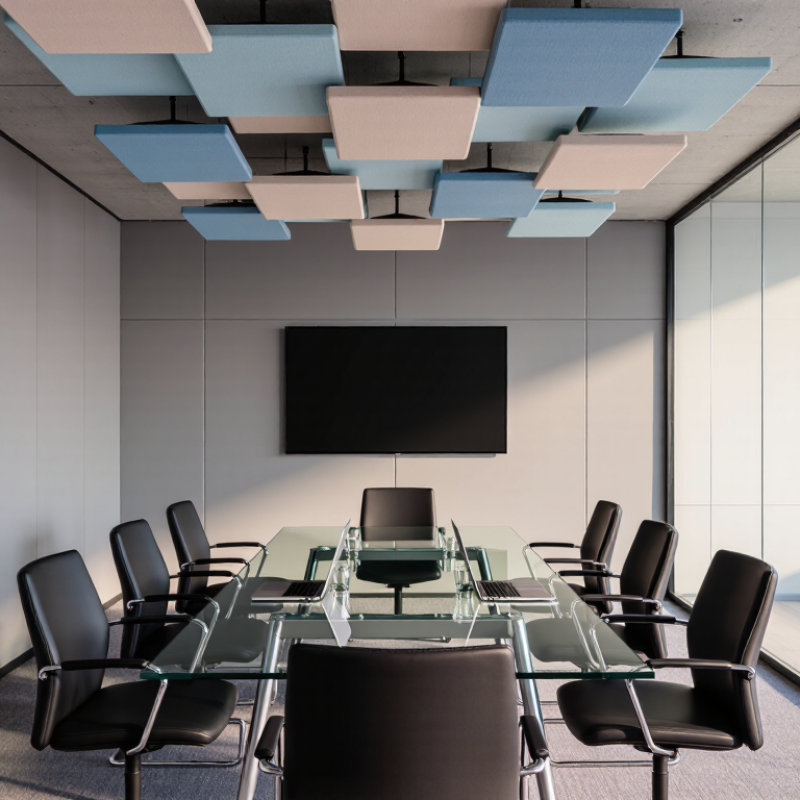
Design options include wall panels, ceiling clouds, and suspended baffles. Clouds can help where wall space is limited, while baffles expose both sides to the room. Color and shape can guide a layout, but coverage should follow the room’s sound paths and intended use. Not every room agrees. A small office and a tall dining hall need different treatment, and too few panels may make little difference. It is worth checking the plan with an acoustics professional, then reviewing results after installation; real rooms can surprise you.
Why Choose Sound-Absorbing Panels?
Compare common panel materials by their indicative Noise Reduction Coefficient (NRC) ranges.
NRC is a rounded measure of sound absorption; higher values indicate greater absorption across the tested frequencies. These ranges are indicative, not guaranteed product ratings. Performance varies with thickness, backing, air gap, and installation, so check tested product data for your project. Fabric-wrapped porous panels are a common choice for broad absorption; perforated wood can combine absorption with a decorative finish.
Where Sound-Absorbing Panels Are Used
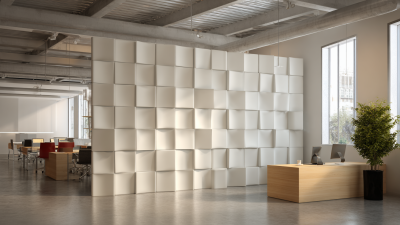
Sound-absorbing panels are used wherever reflected sound makes speech or work harder. In open offices, panels on walls or ceilings can soften conversations and reduce the sharp echo between desks. They do not make a busy office silent. That distinction matters.
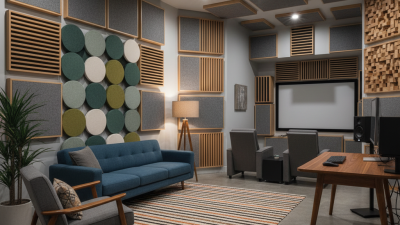
Classrooms often use panels near the back wall, where speech can bounce toward the teacher. In restaurants, ceiling panels can make table conversations easier without removing the room’s lively atmosphere. Recording rooms and music practice spaces use them to control reflections, though panel placement should suit the room and the sound being recorded. A few panels in the wrong spots may change little.
Panels also fit home theaters, meeting rooms, gyms, and shared residential spaces. In healthcare settings, they may help create calmer waiting areas, provided the chosen materials meet cleaning and fire-safety requirements. A practical check is to clap once in the room and listen for a lingering ring. Then consider which surfaces reflect sound and where people actually sit or work. The result is not always dramatic; furniture, room shape, and noise from adjoining spaces still matter.
How to Choose Panels for a Project
Choosing sound-absorbing panels starts with the room’s purpose, dimensions, and dominant noise. Measure the room first. A hard, bright meeting room may need less reflected speech, while a music space may need balanced absorption without losing liveliness. Note ceiling height, glass, flooring, and where people sit. These details affect reflections, so panel placement matters as much as panel quantity.
Use tested performance data, not appearance alone. The Noise Reduction Coefficient (NRC), measured under ASTM C423, summarizes absorption across four mid-range frequencies; it does not describe performance at every frequency. Ask for test results and check whether the product’s tested mounting matches your planned installation. For classrooms, ANSI/ASA S12.60-2010/Part 1 sets reverberation-time limits of 0.6 seconds for core learning spaces up to 10,000 cubic feet, and 0.7 seconds for spaces from 10,000 to 20,000 cubic feet. Treat these as project-specific benchmarks, not universal targets. On site, a common mistake is covering every wall before listening to the room. Start with measured problem areas, then reassess after installation. It is easy to overcorrect. Also confirm panel thickness, edge details, cleanability, and applicable fire-performance documentation with the project team.