| Supplier capability |
Manufacturer, exporter, or trading company; production control; experience with the target market. |
Ask who makes the board, which processes are performed in-house, and which steps are subcontracted. These arrangements vary by supplier. |
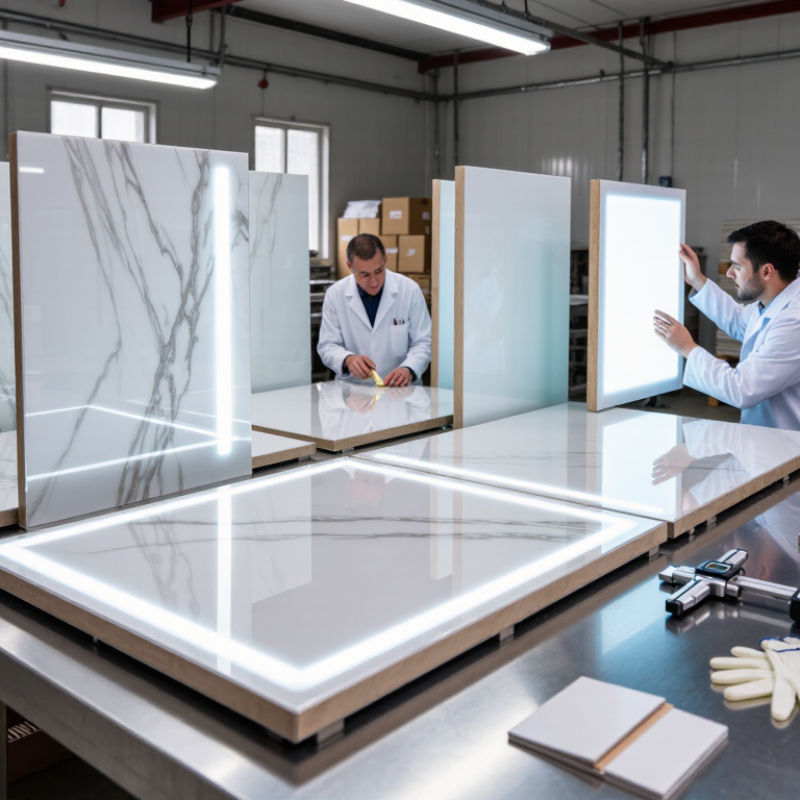
Request a live factory video tour or an agreed third-party audit, production-flow details, and recent shipment records with sensitive information redacted. |
| Core material |
Substrate composition and construction. |
UV marble boards commonly use a rigid sheet substrate, often PVC-based. Core composition and any reinforcement or additional layers must be confirmed for each product. |
Obtain a written material declaration and a labeled sample. Check that the sample, specification sheet, and order description refer to the same SKU. |
| Thickness and size |
Nominal and measured thickness, sheet dimensions, flatness, and tolerances. |
Thickness and dimensions depend on the product. A 1220 × 2440 mm sheet is a commonly offered format; confirm availability, tolerances, and packing dimensions. |
Measure samples at several points with suitable calipers and check sheet dimensions. Put agreed tolerances and inspection rules in the purchase contract. |
| Surface finish |
Print pattern, gloss level, texture, coating uniformity, and edge quality. |
Available finishes may include glossy, matte, or textured effects; colors and marble patterns can vary between production batches. |
Approve a signed or otherwise traceable reference sample. Request batch-matching controls and inspect color, surface defects, and edges before shipment. |
| UV coating performance |
Coating adhesion, scratch and abrasion resistance, chemical resistance, and weathering claims. |
Performance depends on the coating system, substrate, and test method. Do not treat “UV” in the product name as proof of a particular outdoor service life. |
Request reports for the exact product and test conditions. Where relevant, specify recognized methods, such as ASTM D3359 for coating adhesion or ISO 4892-3 for laboratory weathering exposure. |
| Application suitability |
Interior or exterior use, installation method, temperature conditions, and exposure to moisture or sunlight. |
Suitability is product-specific. Ask whether the board is intended for the actual installation environment and whether additional sealing or support is required. |
Review the technical data sheet and installation instructions. Test a representative assembly if the application involves demanding environmental conditions. |
| Quality consistency |
Inspection plan, batch traceability, defect criteria, and pre-shipment inspection. |
Compare documented inspection steps and acceptance criteria rather than relying on general quality claims. |
Agree on a sample approval process, inspection checklist, defect limits, and remedies before production. Consider independent inspection for significant orders. |
| Compliance documents |
Applicable product, chemical, fire, or environmental requirements for the destination market. |
Required documents depend on the application and destination. A certificate or test report should identify the product, issuing body, test method, and validity where applicable. |
Check the issuing organization and report scope; confirm that the tested construction matches the quoted board. Verify destination-market requirements independently. |
| Order terms |
Minimum order quantity, sample charges, lead time, payment terms, and packaging. |
These are supplier- and order-specific; there is no single standard MOQ or lead time that applies to all buyers. |
Compare written quotations on the same quantity, specification, packaging, shipping term, and delivery destination. Confirm production and dispatch milestones. |
| Total landed cost |
Product price, protective packaging, freight, insurance, duties, and inspection costs. |
A lower unit price does not necessarily mean a lower delivered cost. Sheet size, weight, packing method, and shipment volume can affect logistics costs. |
Request a clearly itemized quotation and calculate the delivered cost using the same shipping basis and destination for every offer. |
| Warranty and support |
Coverage, exclusions, claim evidence, response time, and replacement or refund process. |
Warranty length and coverage are contractual terms, not universal product specifications. |
Get the warranty in writing and check that it covers the intended use, installation conditions, and a practical process for reporting defects. |